Showing posts with label joe. Show all posts
Showing posts with label joe. Show all posts
12.29.2010
The Film Buff Blog Is Dead. Long Live The Film Buff Blog.
As of now, all posts/reviews/commentary will take place over at the mother site, where the blog has been integrated for a cleaner look and a better user interface. So, while a stray post may rarely pop up here, you should consider this blog effectively dead, and head to thefilmbuff.com for all future musings. Please adjust your bookmarks accordingly.

11.16.2010
10.24.2010
Four great haunted house movies
The "haunted house" is one of my favourite subjects in the realm of horror. Ghosts, madmen, torture, dark secrets; all are contained within the dank stone walls of these particularly troubled mansions. What follows is (quite obviously) not a complete list, but a small sampling of some of the best the subgenre has to offer.
The Haunting (1963)
 Robert Wise's interpretation of Shirley Jackson's The Haunting of Hill House is considered by many to be the granddaddy of all haunted house films. And with good reason, I now see, after first viewing it just last night. I'm not sure that this film can be topped for its class and restraint, its lack of reliance on visual cues, and its study not of supernatural phenomena and ectoplasmic occurrences, but rather of the ghosts of the mind and the soul.
While featuring all the usual trappings of the haunted house picture (dark corridors, forbidden rooms, cobwebs, and things that go bump in the night), The Haunting is a study of psychological and emotional frailty, where one's greatest fear isn't some wispy apparition, but the very real fear of being forgotten, unloved, of dying alone. That I found Julie Harris' Nell to be both annoyingly martyrish and shrewy as well as heartbreakingly lost and desperate for something to cling onto is a testament to the actress' craft. Russ Tamblyn's unbelieving frat boy, Richard Johnson's tea and tweed paranormal researcher, and Claire Bloom's Sapphic-leaning clairvoyant all round out the solid cast.
What gets me about The Haunting is that there is actually very little in the way of your typical "haunting". And you have to think that Wise was a fan of Hitchcock's Psycho, released three years earlier; if Harris' "stolen car" sequence near the beginning of the film, replete with scared, uncertain voice-over, is anything but a tribute to the master, it is nothing at all. While I wasn't as taken with The Haunting as I thought I might be (unrealistically high expectations have a habit of doing that), it is a very, very good film, and one any horror/haunted house fan should see if they haven't already.
The House on Haunted Hill (1959)
 What we have here is almost the exact opposite of The Haunting, filled with deliciously exaggerated acting and cheap frights. Where The Haunting might be likened to being lost in a slowly darkening forest, The House on Haunted Hill is akin to a carnival spook-house. But that's not to say it is any way the inferior film, and in many ways I preferred the William Castle gimmickry and the hammy acting of my lord and saviour, Vincent Price as Frederick Loren. And there are a few genuinely dark moments, and at least one sequence where I actually jumped, even though I knew exactly what was coming. Effective stuff, indeed. The best of the cast here (other than VP, natch) are Spider Baby's Carol Ohmart as Price's conniving, cold-hearted bitch of a wife Annabelle. So, so great. Elisha Cook's scared souse Watson Pritchard bookends the rest of the group, all hoping to collect the $10,000 promised them for simply spending the night (and surviving) in Loren's home. Great, light fun.
The Changeling (1980)
"How did you die Joseph? Did you die in this house? Why do you remain?"
 This Canadian classic is not only one of my favourite haunted house films, but one of my favourite horror films period. George C. Scott is terrifically cast as a pianist mourning the recent freakishly accidental death of his wife and daughter, and has holed up in a chilly, isolated mansion in order to lose himself in his work. He soon realizes that there is something else in the house with him. What follows certainly ranks among the most spine-tingling ghost stories ever to be filmed. Haunting, elegiac, moving, and at times, blood-curdling, The Changeling is a bona fide classic. Melvyn Douglas provides great support as a senator with a dark past. If there is one film on this list that I must insist you watch if you haven't, it is this one.
The Legend of Hell House (1973)
 I've said it before and I'll say it again, The Legend of Hell House is a true treat. Do yourself a favour and check it out. A giant of the genre.
So, what are your favourite haunted house flicks?
10.22.2010
10.21.2010
10.20.2010


10.15.2010
At Midnight I'll Take Your Soul (1964)
 Where to even begin with this one? Written, directed by and starring the inimitable Jose Mojica Marins, At Midnight I'll Take Your Soul is the film that kickstarted the Coffin Joe franchise. And what a franchise it is: roughly 15 films featuring Coffin Joe, with the majority of them played by Marins. Earlier in the year I ordered the handsome PAL box set which contains eight Joe films plus a documentary entitled The Strange World of Jose Mojica Marins (the NTSC set, which contained three films, is long OOP, but we have them at the FBW). How can you not love it? Along with that, I picked up the most recent Joe film, Embodiment of Evil, sadly as-yet-unreleased in NA. But enough about my acquisition fever, let's get on to the film itself.
 AMITYS is such a strange trip. The plot concerns a small town's sadistic gravedigger who is obsessed with finding a woman to bear his seed and continue his bloodline. But the plot is neither here nor there - we get an evil witch, the walking dead, and a truly trippy vision of vengeful ghosts mixed with all kinds of supernatural strangeness. Coffin Joe is the highlight, of course, and anyone who defies him is dealt with brutal, graphic violence. There are a few scenes sprinkled throughout the film where Joe truly gets to lay bare his bleak world view - there is no life after death, there is no God, there is no Satan, there is only LIFE. And in this one life, Joe has chosen to live it exactly as he desires, indulging in all earthly pleasures. Wine, sex, violence, power; Joe swims in it all, fears no one or no thing, and laughs in the face of religious cowards. Joe is a non-believer, or rather, a believer in the here and now, whatever he can experience through sensual means. Quite simply, Joe is a hero for our times.
 The sound mix on the film is incredibly muddy, although there are some near supernatural moments that sound like the actors are delivering their lines inside an echo chamber. Spooky stuff. The cinematography is lurid, but the black and white tones are starkly stunning. This is crude filmmaking, in the very best sense of the word - raw, unrefined, pure. Not much actually happens in the film - between the taverna, Joe's house, the graveyard, and the windswept woods that connects them all, locations and scenarios are limited, and we find ourselves watching a fairly repetitive film. None of it matters though, because Joe is so deliriously over the top and fun to watch that you forget the film's shortcomings.
 Marins conveys a singular vision that is in no way diluted as the series rolls along - something that can be said of very, very few horror franchises. Coffin Joe may not be as recognizable a name in the horror canon as Jason or Freddy, but he has every right to be. You'll have a hard time finding a more consistently sadistic, evil character in horror cinema. I'd recommend any of the Coffin Joe films, but AMITYS holds a special place in my heart as it was introduction to the Coffin Joe and has left an indelible imprint on my mind. All hail Jose Mojica Marins!
Sole Survivor (1983)
Not to be confused with the made for TV William Shatner vehicle, or some Kensington cobbler, this Sole Survivor is a subtle, eerie portrayal of guilt, depression and confusion, and the very real "horror" that those emotions suggest.
 In keeping with the quiet, creeping dread of earlier films like Herk Harvey's Carnival of Souls or Willard Huyck and Gloria Katz' Messiah of Evil, Sole Survivor tells the story of Denise (Anita Skinner), the - wait for it - sole survivor of a horrible plane crash, of which we are shown the grisly aftermath during the film's opening scene. The rest of the film plays out very much in Final Destination mode (albeit with much less gratuitousness and spectacle), with death sending his minions to collect what should have been rightfully his.
Helmed in a workmanlike fashion (but with a strange, austere artistry) by Thom Eberhardt (Night of the Comet), Sole Survivor is one of those forgotten jewels of the VHS era, only recently exhumed by Code Red. And for that, we can all be grateful, as what we have here is a compelling film that is better off in your DVD player than in a Blockbuster delete bin.
As Denise, Skinner is an incredibly sympathetic character, tough and fragile at the same time, trying so very hard to keep a smile on her face and her head held high, but we get the sense that somewhere just beneath the surface, cracks have formed and are beginning to take hold. What makes the outcome of the film all the more shocking and brilliant is that following her crash, she has found love, and things are beginning to look up. Oh dear, she couldn't be more wrong.
 Skinner authors a very complex character in what could have been a much less touching role. Her nuanced performance makes the film and elevates it from a forgotten also-ran to a rediscovered gem. Making this all the more remarkable (and - if you'll play along with me - a touch creepy) is the fact that this is one of only two of Skinner's film credits. She had a role in the 1978 film Girlfriends, then poof, right off the map. A cursory internet search turned up nothing else as to what she did next, or her current whereabouts.
Sole Survivor offers up an icy, crawling horror that comes from the slow realization that the impossibly terrifying is not only possible, but probable, and that more often than not, there are no happy endings. I watched the film three days ago and it's stuck with me in the way the best horror does - it doesn't seek to shock, but to disturb, to burrow its way into your unconscious and lie there for a spell, reminding you every once in awhile that everything is not as peachy as it seems. Highly recommended.
Dagon (2001)
One of the few good things about being suddenly, unexpectedly (temporarily, I hope) crippled is that I've had a chance to catch up on my film viewing. I've had Stuart Gordon's Dagon more or less near the top of my "to watch" pile for over a year now, and with yesterday's torrential rain and general gloominess, I figured it was time.
 Gordon again turns to Lovecraft as his inspiration for this tale (actually a conflation of two Lovecraft stories, "Dagon" and "The Shadow Over Innsmouth"), in which a young couple is stranded in a small Spanish fishing village after a boating accident, though it soon becomes very apparent that all is not bueno in this seemingly sleepy town. When Barbara (the fetching Raquel Merono) goes missing soon after their arrival, Paul (Ezra Godden) tries to track her down only to be overcome by a horde of garish fishmen. Or rather men who are slowly transforming into piscine form, including all that transformation might entail (hobbled walking, garbled speech, and grotesque physical mutation). After a chance run in with Ezequiel (Francisco Rabal), Paul learns the terrible secret of the town, one in which the denizens relinquished their faith in God when fish stocks ran low and turned to an older, more powerful deity, Dagon, who blessed the town with untold oceanic bounty and gold and treasure, but left them cursed with their current plight, the offspring of all his untold trysts with human women being the current crop of fishmen.
 First, the good: Gordon succeeds in creating a oppressive and chilly atmosphere where rain and darkness are the norm, and twisty, cobbled streets mirror Paul's own confusion. The makeup effects are stellar, and the briny disciples of Dagon look as alien as they do human, and embody both of these aspects in their speech and actions as well. The largely Spanish cast do excellent work as the lurching, slimy humanoids from the deep, minds filled with a singular, murderous intent. And the small Spanish village of Combarro that was the location of the shoot provides a delightfully damp and depressive tone. Looks like a nice place to visit, though you'd probably want to stay away during the rainy season.
 There are some terrific practical effects, the most notable the scene in which Ezequiel is strung up and has his facial skin stripped from his body. Again, Gordon looked to the locals for makeup duties, and they come through in spades. Tentacular appendages and probing probosci simultaneously repulse and delight.
And now, the bad: I know I must sound like a broken record by this point, but the CGI employed in the film is worse than awful. Mega Shark vs Giant Octopus provided a better sense of reality than some of the VFX in Dagon. I think this is an unfortunate side-effect of the year in which the film was made. 2001 had filmmakers excited about the possibility of CGI, even though the technology wasn't quite there to back up the boundless visions of some of the brighter directors. The technology was in a dangerous nascent phase that allowed directors to employ it without it being fully developed, to the overall detriment of their final vision. Granted, it would probably have been prohibitively pricey for Gordon and crew to build a massive model of the enormous mer-god Dagon, but he could very easily have taken the route John Carpenter did in In the Mouth of Madness, his Lovecraftian puppet-beasties sprang from the screen and seemed much more menacing than some green-screened squid. Or even do what he had done earlier in the film and suggest (a la Val Lewton) the kraken-king through creative camera angle and actor responses. The poorly done CGI is all the more glaring when juxtaposed with the expertly done practical effects, and the whole thing becomes jarring and takes you out of the film. Regardless, barring the visual let down of the climax and a couple other ill-advised effects throughout, Gordon does a credible job overall capturing the mood of the Lovecraft original.
The casting of Godden as Paul also strikes me as a strange choice - I mean his type is right, but the actor himself can't seem to decide whether to play the role as camp or straight-up, and his wavering between the two leaves the performance wooden. There isn't a great chemistry (read: none at all) between he and Merono's Barbara, either. Really the only good thing about his wholly unlikeable persona was his Miskatonic sweatshirt, a sly wink by Gordon at observant Lovecraft fans.
 Overall, Dagon is worth a look, for sure, but falls somewhat shy of the best cinematic Lovecraft adaptations. If you're looking for a Lovecraft-on-film primer, seek out the superior gallows humour of Re-Animator and the ultra-weird, candy-coloured From Beyond (both by Gordon as well), or even older fare such as The Shuttered Room. I'm not generally an advocate of remakes, but I'd love to see someone (even Gordon himself) take another stab at the Dagon story, either with the complete use of practical effects or prudent use of updated CGI technology. Let's hope Guillermo del Toro heeds these guidelines when bringing the epic At The Mountains of Madness to the screen in 2013. Huge fingers crossed on that one, though del Toro has yet to disappoint.
 Gordon again turns to Lovecraft as his inspiration for this tale (actually a conflation of two Lovecraft stories, "Dagon" and "The Shadow Over Innsmouth"), in which a young couple is stranded in a small Spanish fishing village after a boating accident, though it soon becomes very apparent that all is not bueno in this seemingly sleepy town. When Barbara (the fetching Raquel Merono) goes missing soon after their arrival, Paul (Ezra Godden) tries to track her down only to be overcome by a horde of garish fishmen. Or rather men who are slowly transforming into piscine form, including all that transformation might entail (hobbled walking, garbled speech, and grotesque physical mutation). After a chance run in with Ezequiel (Francisco Rabal), Paul learns the terrible secret of the town, one in which the denizens relinquished their faith in God when fish stocks ran low and turned to an older, more powerful deity, Dagon, who blessed the town with untold oceanic bounty and gold and treasure, but left them cursed with their current plight, the offspring of all his untold trysts with human women being the current crop of fishmen.First, the good: Gordon succeeds in creating a oppressive and chilly atmosphere where rain and darkness are the norm, and twisty, cobbled streets mirror Paul's own confusion. The makeup effects are stellar, and the briny disciples of Dagon look as alien as they do human, and embody both of these aspects in their speech and actions as well. The largely Spanish cast do excellent work as the lurching, slimy humanoids from the deep, minds filled with a singular, murderous intent. And the small Spanish village of Combarro that was the location of the shoot provides a delightfully damp and depressive tone. Looks like a nice place to visit, though you'd probably want to stay away during the rainy season.
 There are some terrific practical effects, the most notable the scene in which Ezequiel is strung up and has his facial skin stripped from his body. Again, Gordon looked to the locals for makeup duties, and they come through in spades. Tentacular appendages and probing probosci simultaneously repulse and delight.
And now, the bad: I know I must sound like a broken record by this point, but the CGI employed in the film is worse than awful. Mega Shark vs Giant Octopus provided a better sense of reality than some of the VFX in Dagon. I think this is an unfortunate side-effect of the year in which the film was made. 2001 had filmmakers excited about the possibility of CGI, even though the technology wasn't quite there to back up the boundless visions of some of the brighter directors. The technology was in a dangerous nascent phase that allowed directors to employ it without it being fully developed, to the overall detriment of their final vision. Granted, it would probably have been prohibitively pricey for Gordon and crew to build a massive model of the enormous mer-god Dagon, but he could very easily have taken the route John Carpenter did in In the Mouth of Madness, his Lovecraftian puppet-beasties sprang from the screen and seemed much more menacing than some green-screened squid. Or even do what he had done earlier in the film and suggest (a la Val Lewton) the kraken-king through creative camera angle and actor responses. The poorly done CGI is all the more glaring when juxtaposed with the expertly done practical effects, and the whole thing becomes jarring and takes you out of the film. Regardless, barring the visual let down of the climax and a couple other ill-advised effects throughout, Gordon does a credible job overall capturing the mood of the Lovecraft original.
The casting of Godden as Paul also strikes me as a strange choice - I mean his type is right, but the actor himself can't seem to decide whether to play the role as camp or straight-up, and his wavering between the two leaves the performance wooden. There isn't a great chemistry (read: none at all) between he and Merono's Barbara, either. Really the only good thing about his wholly unlikeable persona was his Miskatonic sweatshirt, a sly wink by Gordon at observant Lovecraft fans.
 Overall, Dagon is worth a look, for sure, but falls somewhat shy of the best cinematic Lovecraft adaptations. If you're looking for a Lovecraft-on-film primer, seek out the superior gallows humour of Re-Animator and the ultra-weird, candy-coloured From Beyond (both by Gordon as well), or even older fare such as The Shuttered Room. I'm not generally an advocate of remakes, but I'd love to see someone (even Gordon himself) take another stab at the Dagon story, either with the complete use of practical effects or prudent use of updated CGI technology. Let's hope Guillermo del Toro heeds these guidelines when bringing the epic At The Mountains of Madness to the screen in 2013. Huge fingers crossed on that one, though del Toro has yet to disappoint.
10.12.2010
Asylum (1972)
 Another day, another anthology. This time it's the intriguing Amicus joint Asylum starring basically every British actor ever. No? Okay, how 'bout this: Peter Cushing, Barry Morse, Herbert Lom, Britt Ekland (oh man), Patrick Magee, Charlotte Rampling (oh MAN!), and a bunch of other people you've probably never heard of but would recognize if you've watched anything from Amicus/Hammer from the '60s/'70s or essentially anything on the BBC from that time.
The setup for this one is a doozy - Dr. Martin (Robert Powell) sets off from London to take a new job at an asylum for the incurably insane, although the doctor who greets him (Magee) is not the doctor who summoned him there in the first place. No, Magee's Dr. Rutherford informs Martin that Dr. Byron has himself gone mad and is now confined upstairs with the other patients. And if Martin can figure out which of the patients is Dr. Byron, Rutherford will consider him fit for the position. And off we go...
Rutherford is greeted by the orderly, from whom he tries to extract clues as to the personage of Byron, but the orderly knows better - the game is afoot! From there, we are taken into each of the four patients' rooms, each with a different story of how they came to be there in the first place. And for once, the framing narrative is actually just as, if not more, compelling than the individual stories themselves. Not to say that they are inferior to other Amicus anthologies, but they do at times seem to drag.
 The first story (Frozen Fear) concerns Bonnie (Barbara Perkins), who was conspiring with adulterer Walter (Richard Todd) to bump off his voodoo-obsessed wife Ruth (Sylvia Syms) so they could go on the make together. Well, as one would expect from this EC-styled segment, Ruth bites it, and is hacked to pieces by Walter. However, the body parts (presumably aided by some sort of voodoo powers) arise and destroy not only the unfaithful husband, but also gets to Bonnie, who, in an attempt to save herself, hatchets away at her face to remove the disembodied hand clinging to it. And we're brought back to the asylum, where Bonnie shows off her scars, rather delightedly, to Martin. Is this Byron? Martin is unsure, which takes us to the next patient...
 Behind door number two, we find Bruno (Morse), who at first gaze appears to be fashioning the emperor's new clothes, complete with invisible needle and thread. What has caused this madness? We find out, in The Weird Tailor. Bruno is an old-school tailor who is behind on the rent, and his displeased landlord gives him until the end of the week to come up with the cash or find new digs. Bruno is at a loss: how to get the money? Ah, but lo and behold a very distinguished and somewhat mysterious gentleman enters the shop as if to answer Bruno's prayers. Mr. Smith (Cushing) commissions a suit made of a strange glowing fabric (Hypercolour FTW!), with very strict specifications that the suit only be worked on between the hours of midnight and 5 am. And the handsome sum of 200 pounds is promised to Bruno upon the suit's completion, more than the tailor needs to settle his rent. All week Bruno toils in the dead hours of the night and finally completes the suit. Upon delivery to Smith, he discovers that dark purpose for the suit that involves raising the dead. He also discovers that Smith has no money to pay him. Anyway, things turn out real crazy and a mannequin in the tailor's shop on which the suit is placed ends up coming to life and nearly destroys Bruno. At least it destroys his mind. Martin is still unconvinced that he has met Byron, and asks to see the next patient, the ravishing...
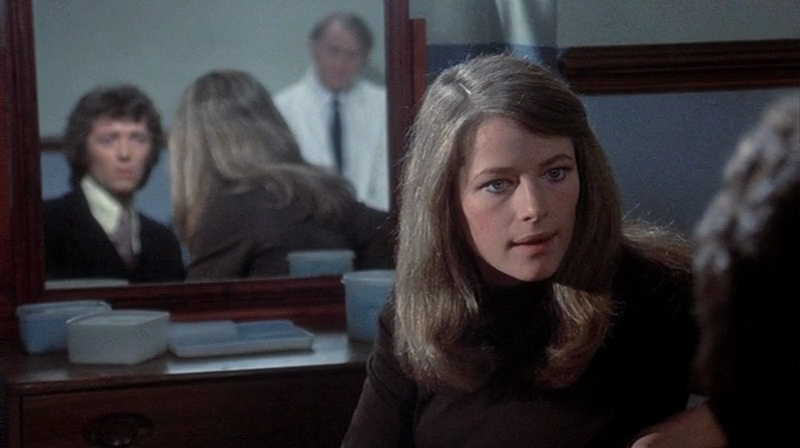 Barbara (Rampling). Barbara is the first to seem sane, at first. Then comes her story (Lucy Comes To Stay), which is weakest of the bunch, but makes up for it by featuring both her loveliness and the swingin' sexpot styles of Britt Ekland (naked Wicker Man wall-hump, anyone? Start at 1:15). This one isn't really worth recounting, but it involves a scheming older brother trying to get his hands on Barbara's inheritance by proving she's either insane, addicted to pills, or both. At the end of the segment, I didn't really care, I just wanted more Rampling/Ekland action. I think the producers knew that this story was the weakest of the four, and compensated by upping the pulchritude power. Martin is getting antsy at this point, thinking he's being strung along by Rutherford, and asks to see the final patient, in what is the shortest and most gonzo of the tales...
 Which brings us to Dr. Byron's (Lom) room, for the segment Mannikins of Horror. Byron seems sane enough, but soon reveals he's out of his gourd by showing off his collection of miniature robots with very lifelike human faces. Each of these, he informs Martin, represents a different real life person, and is exact inside down to the very last detail. His latest creation is a tiny robot in his own likeness, which will soon be given life through "the power of concentration"(?). Thank you, says Martin, I've seen enough. He and the orderly make their way out of the ward, and Martin returns to Rutherford. Martin exclaims that he will not choose and does not appreciate being subjected to the whimsical games of the doctor. While they argue, we see cuts to Byron's room, where he lies in darkness, eyes focused on his little doppelganger, concentrating life into the little guy. Well, goddamn, it works! Through a series of improbable (given the robot's lack of great mobility) events, the robot enters Rutherford's office and stabs the doc in the back of the neck with a scalpel! This segment is just so bizarre it needs to be seen.
Directed by the venerable Roy Ward Baker (who helmed countless Hammer and Amicus films, and who sadly passed away just a week ago, aged 93), and written by Robert Bloch (Psycho), Asylum is a fun little romp. The actors all pull off their roles with great aplomb, and while some of the stories are weaker than others, the whole thing is kept interesting by the overarching narrative. Which, it must be said, is fairly easy to figure out (I guessed correctly at the conclusion five minutes into the film). If you're a fan of anthology horror, mysteries, Charlotte Rampling and/or Britt Ekland, check it out. I'm not going to say it's a "must see" because, frankly it's not; however, you won't feel like you've wasted your time when it's all said and done. Don't rabidly track it down, but if you see a lonely copy gathering dust at your local independent video store, give it a whirl. You won't be disappointed.


10.08.2010
Dark Night of the Scarecrow (1981)
 As made for TV movies go, 1981s Dark Night of the Scarecrow is as good as it gets. Previously available only on a long OOP VHS, VCI recently released a stunning looking DVD of this horror/revenge minor classic.
Starring the venerable Charles Durning and Larry Drake (Darkman, L.A. Law, Dr. Giggles), Dark Night of the Scarecrow is a slowburn, quiet creeper, less gratuitousness and more skin-crawling tingles.
Bubba (Drake) is the village idiot, and after a girl is attacked, postmaster Otis (Durning) and his cronies make a rash decision to take vigilante justice on the presumed guilty Bubba, and after a tense hunt, they find Bubba hiding in the fields as a scarecrow. Helpless on the cross, Bubba is gunned down in cold blood by the rage-blinded men. Soon after, they discover that Bubba had actually saved the girl's life, and their decision to take a man's life was in vain. However, because of a grudge held toward Bubba, this action doesn't seem to weigh too heavily on any of the men's souls...until they start getting picked off by an unseen force, one by one.
 The cast is better than it has any right to be, but Durning is especially sterling as his usual mealy-mouthed, greasy, conniving self. Drake is wonderfully sympathetic in a sort of Frankenstein's monster role.
The pacing of the film is terrific, and the sense of vindication in the viewer grows alongside the fear felt by the perpetrators of the heinous crime. There aren't any "cheap scares", and every fear that the antagonists hold is played out in agonizingly long detail. The last five minutes are truly something to behold, filled with a creeping dread that is so regrettably absent from most modern "horror". With thumbs up from Vincent Price, Ray Bradbury, Stuart Gordon, and me, Dark Night of the Scarecrow is a much appreciated resurrected gem that can be appreciated by the dyed-in-the-wool genre fan as well as Scott. Watch it. I'm gonna wear my Fright Rags DNOTS t-shirt (funnily enough, now itself OOP) tomorrow.

Let Sleeping Corpses Lie (1974)
"You're all the same, the lot of you, with your long hair and faggot clothes. Drugs, sex, every sort of filth. And you hate the police, don't ya?"
"You make it easy."
Aka The Living Dead at Manchester Morgue, aka Breakfast at the Manchester Morgue, aka Don't Open the Window, Do Not Speak Ill of the Dead, aka Zombi 3, aka at least half a dozen other titles depending on the country in which it was released, Jorge Grau's zombie opus Let Sleeping Corpses Lie (the title on my Blue Underground DVD) has an international pedigree worthy of its plethora of monikers.
Directed by a Spaniard, starring a half Brit-half Italian (Ray Lovelock), a Spaniard (Cristina Galbo), an American (Arthur Kennedy), and a host of Spanish and Italian character actors in minor roles, and shot mainly in the English countryside around Manchester and Yorkshire, Let Sleeping Corpses Lie is a strange and wonderful horror film. Taking cues from Night of the Living Dead, the Manson murders, environmental fears and generational unrest, it is shocking to realize Grau's film presaged Romero's Dawn of the Dead by four years.
We begin with George (Lovelock) locking up his London curio shop and goin' up the country for a weekend of R&R. An ill-fated gas station encounter with spacey Edna (Galbo) leaves the two of them traveling together, not by choice, to Edna's sister's house. A couple wrong turns and an unfamiliar landscape soon see the pair among markers such as rolling hills, oaks and streams instead of signs for Leicester Square.
 As they stop to ask for directions, Edna is attacked by a man with blood red eyes (this is, coincidentally enough, 28 years before the rage virus induced similarly scarlet orbs in 28 Days Later...) and a like thirst for the crimson stuff. George, who was over the hill asking a farmer for directions, shrugs off Edna's hysteria as a mixture of fatigue and the possibility of her exaggerating an encounter with a tramp. Later that night, Edna's sister's husband is killed by the same man who attacked Edna, and as the police get involved, there is an immediate friction between the inspector (Kennedy) and George.
 The anti-authoritarian, long-haired, bearded and hiply-garbed George doesn't go over well in small town England a mere five years after the Tate-LaBianca murders, and nor does the inspector's hard-headedness and bigotry sit well with George. As bodies begin to pile up and the dead begin to rise (highlighted in one chilling scene at the...uh, the Manchester Morgue), the two poles of George and the inspector pull further apart and we see the clash between rational thought and blind belief taken to the extreme.
 Having more in common with Robin Hardy's The Wicker Man than, say, Lucio Fulci's Zombie (though there's enough graphic grue on display to please the gorehounds), Let Sleeping Corpses Lie is a smart, well-acted, moody (owing largely to the chilly, grey, misty English countryside) horror film in which the director's reach does not exceed his grasp. There is a terrific one-two punch of an ending, but be warned - Blue Underground released two versions of this within a year of each other, the regular titled Let Sleeping Corpses Lie, and the special edition titled The Living Dead at Manchester Morgue. If you pick up the latter (which we have in stock at the FBE), please ask a staff member to help you find it and be sure not to look at the DVD cover, as it contains a MAJOR spoiler. I guess BU assumed everyone buying/renting this had already seen it, but still...that's weak.
Anyway, if you count yourself among the zombie faithful and have yet to see this one, move it to the to the top of your pile. Highly recommended.
"You make it easy."
Aka The Living Dead at Manchester Morgue, aka Breakfast at the Manchester Morgue, aka Don't Open the Window, Do Not Speak Ill of the Dead, aka Zombi 3, aka at least half a dozen other titles depending on the country in which it was released, Jorge Grau's zombie opus Let Sleeping Corpses Lie (the title on my Blue Underground DVD) has an international pedigree worthy of its plethora of monikers.
Directed by a Spaniard, starring a half Brit-half Italian (Ray Lovelock), a Spaniard (Cristina Galbo), an American (Arthur Kennedy), and a host of Spanish and Italian character actors in minor roles, and shot mainly in the English countryside around Manchester and Yorkshire, Let Sleeping Corpses Lie is a strange and wonderful horror film. Taking cues from Night of the Living Dead, the Manson murders, environmental fears and generational unrest, it is shocking to realize Grau's film presaged Romero's Dawn of the Dead by four years.
We begin with George (Lovelock) locking up his London curio shop and goin' up the country for a weekend of R&R. An ill-fated gas station encounter with spacey Edna (Galbo) leaves the two of them traveling together, not by choice, to Edna's sister's house. A couple wrong turns and an unfamiliar landscape soon see the pair among markers such as rolling hills, oaks and streams instead of signs for Leicester Square.
 As they stop to ask for directions, Edna is attacked by a man with blood red eyes (this is, coincidentally enough, 28 years before the rage virus induced similarly scarlet orbs in 28 Days Later...) and a like thirst for the crimson stuff. George, who was over the hill asking a farmer for directions, shrugs off Edna's hysteria as a mixture of fatigue and the possibility of her exaggerating an encounter with a tramp. Later that night, Edna's sister's husband is killed by the same man who attacked Edna, and as the police get involved, there is an immediate friction between the inspector (Kennedy) and George.
 The anti-authoritarian, long-haired, bearded and hiply-garbed George doesn't go over well in small town England a mere five years after the Tate-LaBianca murders, and nor does the inspector's hard-headedness and bigotry sit well with George. As bodies begin to pile up and the dead begin to rise (highlighted in one chilling scene at the...uh, the Manchester Morgue), the two poles of George and the inspector pull further apart and we see the clash between rational thought and blind belief taken to the extreme.Having more in common with Robin Hardy's The Wicker Man than, say, Lucio Fulci's Zombie (though there's enough graphic grue on display to please the gorehounds), Let Sleeping Corpses Lie is a smart, well-acted, moody (owing largely to the chilly, grey, misty English countryside) horror film in which the director's reach does not exceed his grasp. There is a terrific one-two punch of an ending, but be warned - Blue Underground released two versions of this within a year of each other, the regular titled Let Sleeping Corpses Lie, and the special edition titled The Living Dead at Manchester Morgue. If you pick up the latter (which we have in stock at the FBE), please ask a staff member to help you find it and be sure not to look at the DVD cover, as it contains a MAJOR spoiler. I guess BU assumed everyone buying/renting this had already seen it, but still...that's weak.
Anyway, if you count yourself among the zombie faithful and have yet to see this one, move it to the to the top of your pile. Highly recommended.
10.05.2010
The Tomb of Ligeia (1964)
 The very last of Roger Corman's uncannily successful Edgar Allan Poe adaptations, The Tomb of Ligeia is yet another winner. Starring Vincent Price (I'd seriously watch the man read the phone book) as Verdon Fell and treasured Film Buff East customer Elizabeth Shepherd as The Lady Rowena Trevanion, Ligeia breaks somewhat with Corman/Poe tradition as there are many outdoor settings and many scenes shot in daylight. Still, Corman's trademark gothic chill pervades the film, and several of the more unsettling scenes are clothed not in satin drapery but bright sunshine.
The story begins with Fell burying his newlydead wife, the Ligeia of the title, although there is some doubt as to whether or not she is actually dead. A priest implores Fell that he cannot bury his wife in consecrated ground as she died unnaturally. Price chews up this scene, spewing forth dark prophecies about his wife's will being too strong for her to die, and comes across somewhat like the devil himself. A black cat jumps on the coffin and Ligeia's eyes flutter open! Fell informs the priest and the pallbearers that it is simply an effect of rigor mortis.
Later, on a fox hunt, Rowena stumbles across the crumbling abbey where Ligeia is interred, but is thrown from her mount when the black cat returns and spooks the horse. Fell appears from behind a wall and startles Rowena to fainting. From this point on, Rowena is transfixed by Fell's wounded widower, and becomes intent on marrying him. However, that seemingly vengeful cat just won't go away, and interrupts any attempt at intimacy between Fell and Rowena. Is the cat actually the reincarnated soul of Ligeia, who will not rest while any potential suitors for her husband live? Or is the answer more grounded in a shadowy reality, where everything is not as it seems, and those who project a noble countenance actually carry a dark purpose? Such is the beauty of these Corman/Poe adaptations: likely owing to the original literary source, things are rarely as simple as they seem, and there almost always (as there are here) undercurrents of madness, obsession and brooding, buried sexuality.
 As always, Price looks likes he's having an absolute blast with the character of Verdon Fell, and when the truth of his wife's "death" comes out at the end, the mixed sympathies we feel for him throughout the film come crashing down like the mossy stones of the the abbey. While I would have a hard time picking a Price/Poe favourite, this one stands up with the best of them. I still have a couple to watch - and I don't think anything will top Witchfinder General or The Masque of the Red Death - but Ligeia is a fun, occasionally spooky descent into necrophiliac lust and the supernatural. Worth it.
And I can't wait for Ms. Shepherd to brighten our humble shop's door again; I've got many questions (and a few compliments) for her.
10.04.2010
The Legend of Hell House (1973)
 Richard Matheson's countless film and TV writing credits are often overshadowed by his most famous work, I Am Legend, from which three (to date) official adaptations have been made, with many other "last man on earth" films drawing direct inspiration from his original novel. But attention must be paid to the fantastic work he has contributed elsewhere in the cinematic realm, the absolute peak of which, for me, is 1973's The Legend of Hell House.
Directed by John Hough (who would later go on to direct Dirty Mary Crazy Larry, the "Witch Mountain" films, and the supremely creepy "children's" movie, The Watcher in the Woods), The Legend of Hell House begins with a group of four characters - mental medium Florence Tanner (Pamela Franklin), physicist Lionel Barrett (Clive Revill), his wife Ann (Gayle Hunnicutt), and physical medium Benjamin Fischer (Roddy McDowall) - converging on The Belasco House, aka Hell House, the "Mount Everest of haunted houses" we are informed by Lionel. They have been charged by the wealthy Mr. Deutsch with shutting the door once and for all on the haunting. Trouble is, this very same thing had been attempted before, 20 years earlier, and all involved were either killed or crippled and made insane. All but one, that is, McDowall's Benjamin Fischer, returning to the home not for any sense of closure, but simply to shut himself off from any psychic phenomena to which he may be susceptible, wait out the week, collect a paycheck, and bid goodbye to the house forever. The young Miss Tanner and Dr. Barrett have other plans though - Tanner wishes to commune with the spirits in the home through her psychic powers, and Barrett wishes to zap the home of its energies with his newfangled technology. Neither of them see their goals through to the end.

The film plays out in a tastefully restrained fashion a la The Haunting, and some opulent, creaky, cobwebby sets inside the home (as well as the home itself) provide much appreciated eye candy. Director Hough conjures a slow burn build to a simultaneously preposterous and chilling finale. Along the way there are ghostly whispered threats and pleas, a possessed cat, a ghost-rape/possession, an eerie seance, overtones of sexual repression/buried desire, and an uncovered rotting corpse. As the days go by, the screws are tightened, and minds begin to break. Bizarre and often grotesque camera work from Alan Hume (who lensed From Beyond the Grave, among many others) is filled with exaggerated angles, jarring depths of field, and tight compositions, and augments the claustrophobic, disorienting atmosphere of uncertainty and dread.

Executive produced by James H. Nicholson (of American International), The Legend of Hell House has a similar feeling to the films that came out of AIP's stable; brooding, gothic, ghostly, horrific more in their implication than what they actually showed, and with a wonderfully downbeat ending. You could do far worse than to pop in this classic ghost house thriller on a rainy day like this.
10.02.2010
The Stone Tape (1972)

Originally broadcast on the BBC as a Christmas ghost story in 1972, The Stone Tape has gained a significant cult following that belies its humble beginnings. It's greatest pedigree is screenwriter Nigel Kneale, best known for his creation of Bernard Quatermass, the character around whom the Quatermass series and the resulting films are based. The Stone Tape treads in a similar track as the more renowned Quatermass, but while the latter deals mainly with science (and science fiction), the former, and the subject of today's review, delves into superstition and the supernatural, and delivers a nice ghostly chill that the earlier series lacks.
We begin The Stone Tape outside a secluded mansion which has been purchased as a research facility by Ryan Industries. The purpose of the research is for the team to come up with a new recording medium, something beyond tape. As research team leader Peter Brock (Michael Bryant - no, not that one...) says, "Give me Wagner's Ring Cycle on the head of a ball bearing with instant playback". Somewhat quaint, by today's standards; or perhaps prescient? As the team begins setting up equipment in one particularly cavernous room, Jill (Jane Asher, ex-Ms. Paul McCartney) hears echoing footfalls and then a woman scream. As others hear the woman at varying intervals, it is determined that the room is haunted. After attempts are made to expunge the ghost, Brock, with some insistent urging from Jill, realizes that there is not a physical roaming spectre per se, but that the spirit in the room is recorded in the very walls themselves, a "stone tape". What at first seems like a major breakthrough in the team's research (i.e. this is the recording medium that has eluded them thus far), soon becomes something far more sinister as Jill becomes obsessed with and haunted by the spirit and her history, and makes a chilling discovery that the ghost to which they have been witness is simply on the surface, or the first layer of the "tape", and that there are far older things recorded or contained on sub-layers of the stone, back, back in history, back perhaps to when the stone itself was formed. Old, dark, unspeakably malevolent things.

The whole cast here is wonderful, with especially exceptional turns by Asher, Bryant, and Iain Cuthbertson (see also the similarly spooky Children of the Stones). Bryant's team leader is headstrong and vain, and is nearly seized by madness while trying to remove the ghost from the room (in a terrifically psychedelic and possibly seizure-inducing scene) before refusing to acknowledge that what he had clung to so tightly was even a possibility after the experiment has failed. Asher is the typical gothic heroine, fragile and tough in the same package, and one whose pleas and warnings are mostly ignored by the rest of the team, save Cuthbertson's Roy Collins.
The sound and visual effects are dated but work well in reinforcing the theme. Analogue sound and video effects are nowhere near as precise as modern CGI, but the amorphous green shapes and eerie glowing lights the VFX crew conjures up are a perfect match for old, weird things that cannot be described, let alone shown visually. The effects have almost add to the creepiness, because instead of striving for realism and falling hard, they simply embrace the sort of abstract concepts in the play and work marvelously to that end. Some might see the effects as cheesy or dated, but they worked well given the concepts and subject matter of the play.
The final 5 minutes of The Stone Tape are truly chilling and a semi-ambiguous ending leaves the viewer contemplating the terrible consequences and possible outcomes of Jill and Peter's actions for days.
Not available on R1 DVD, there does exist a BFI PAL release, both on tape (how appropriate) and DVD. But since that's probably not going to materialize in either shop soon, here, for your viewing pleasure, is The Stone Tape (part 1 - the rest of the parts are on the Youtube sidebar):
10.01.2010
From Beyond the Grave (1973)

From Beyond the Grave centres around the mysterious and slightly malevolent back-alley antique and oddments shop
As with most anthology films, not all the stories in From Beyond the Grave are created equal; in fact, the two bookending chapters, "The Gatecrasher" and "The Door", are essentially the same story of a centuries old spirit trying to break on through from the other side, just wrapped up in different details. The most touching yarn (as well as the most chilling) is "An Act of Kindness" in which a frustrated man (Ian Bannen) trapped in an unfulfilling marriage happens upon a street vendor (Donald Pleasance) and the two strike up a friendship based on their military history (though Bannen is lying about his). After increased meetings at Pleasance's home and a growing familiarity with his creepy semi-lobotomized daughter (an effectively eerie turn by Donald's real-life daughter, Angela), things take a dark turn and, needless to say, it doesn't end well for ol' Bannen (or his wife).
 The other three tales are wonderfully frightful, and a special mention must go to Margaret Leighton's grandiose medium Madame Orloff in "The Elemental". The best performance - and one of the main reasons for watching - belongs to Cushing, whose sly, knowing proprietor is at once bumbling and malefic.
Low production values are well-hidden, and like I mentioned, staging the tales in the present day allows for much budget-shortfall overcoming. Overall, a worthy anthology, and if you are a fan of the format, you'll certainly find lots to tempt you in here. Come in, come in...
Oh yeah, we don't have this at either store, so if you want to see it, you'll have to ask me. Or buy it on AMAZON.CA!
9.25.2010
Midnight Madness 2010: That's a Wrap!
At the risk of trying your MM bloggage patience, Kris and I have one more post about the fest until next year. Thank you all for reading - the films were almost as much fun to write about as they were to watch. Well, some of them. Anyway, quickly, here's my ranking, from first to worst, of the films we saw:
1: Stake Land
2: Fubar 2
3: Super
3: Red Nights
3: Bunraku
6: The Butcher, The Chef, and the Swordsman
7: The Ward
8: Vanishing on 7th Street
9: Fire of Conscience
10: Insidious
And a special mention must go to The Legend of Beaver Dam, the short which preceded Fubar 2. Tons of fun. And a three way tie for third! I really just couldn't pick which of these three should have been in the three spot, which in the fourth, and which in the fifth, so I did the next best thing: COP-OUT! 1-6 are all certainly worth watching, and films I hope to see again, whether theatrically or on DVD; 7 I'll probably watch again on DVD, maybe, if in the right mood; and 8-10 I hope to never have to soil my eyes with ever again.
Well, we barely survived (again), and I certainly wouldn't have if not for Kris' support and love. And his forcing me to get the Fessenden pic. Until next time, "Filter in, filter in", "EMMA? EMMA?", "Hopping Mad, please". I can't wait until Midnight Madness 2011..
-the coelacanth
------------------------------------------------
It's been about a week since TIFF and Joe and I's endurance run through Midnight Madness ended and I'm just started to feel sane again.
Doesn't mean it wasn't an absolute blast. This years TIFF was a dizzying journey that I can't wait to repeat next year with my partner in crime.
Personal TIFF 2010 highlights: "It's not warm!", Ron Pearlman, a pile of rocks I almost rode into on Dundas St., Larry Fessenden, Liv Tyler, Sasha Grey DJing at The Drake Hotel, C'est What's Bison Burger, "Filter in! Filter in!", booing at the Cadillac ad before every film and finally, the free black gum we received in line for Super.
Of course, it wouldn't be a film festival without the films! So, here's how I rank 2010's Midnight Madness program.
1: Stake Land - "... I prayed, I prayed to God to save me. When they finally came for my blood, I gave it to them willingly and was rewarded for my sacrifice..."
2: The Legend of Beaver Dam - "Who's afraid of Stumpy Sam, the one-armed ghost of Beaver Dam?"
3: Fubar 2 - "...hump dumpers on lube tube."
4: Super - "Touched by the tip, of the tip, of God's finger."
5: Bunraku - "I'm the product of a fucked up generation"
6: Red Nights - "You really are quite pretty..."
7: The Butcher, The Chef and The Swordsman - "I'm dead!"
8: The Ward - "What happened to Alice?"
9: Fire of Conscience - "I was born in the year of the dragon. Dragons are in luck this year."
10: Vanishing on 7th Street - "The only thing that has kept me alive the past 3 days is my will to exist."
11: Insidious - "Dalton has gone to a place... a place I call... 'the further'."
There you have it. Another year, another midnight madness accomplished.
Thank you to everyone who followed our reviews. To Scott for helping us out with that last review and egging us on through the whole run. To Geddes for selecting some absolute gems this year. To my partner Joe, without you... there would be no way. To Sasha Grey for smiling at me. And finally, thank you secret washrooms at the Ryerson theater... you made my festival.
-dropkick.
9.19.2010
Midnight Madness 2010 day 10: Fire of Conscience (2010)
There's really not much to say about Dante Lam's Fire of Conscience, the closing film of Midnight Madness 2010. Which is too bad, It's always better to go out on a bang rather than a whimper.
The film is a Hong-Kong cop drama/thriller that follows a detective who has taken a vigilante-esque stance on crime after his pregnant wife was killed by a purse snatcher. He collaborates with a higher ranking officer on a case to catch a cop killer.
While the first half hour held great promise the plot becomes murkier and murkier as twists come at you in rapid fire. Following the complicated plot wouldn't be such a hassle if you genuinely cared for the characters.
This lack of care results in an anticipation of action sequences to help keep you going, sadly, the ones on display are loud and realistic but are much too short.
The film fails as an action and as a drama. When our hero is delivering a baby in a burning garage by the third act you are laughing at the mundaneness of the whole ordeal and hoping for a quick cut to the end credits.
While there is much promise here coming from director Dante Lam, it's the script that lacks emotionality and cohesiveness. Turning what should be hard hitting into straight to dvd fodder.
Why this was a Midnight Madness pick is beyond me, a film already distributed in North America getting a slot at a world reknown film festival? Was it to help the director get a festival selection credit under his belt? Or maybe it was because the film really did fit with the theme of the festival and was great.... yeah.
If TIFF screens films we already have available for rent, then why not get a print of something real classic? A real crowd pleaser to go out on. That would have been better than this mediocrity.
And with that the festival ends on a low note, but it isn't all bad news. Joe and I caught some really excellent stuff over the past 10 days and now we can finally get some sleep.
-dropkick
-------------------------------------------------------------
It's a shame that after nine days of some wonderful cinematic delights (and a couple troubled productions), Midnight Madness 2010 had to end on a low note, but that's exactly what happened with last night's screening of Dante Lam's Fire of Conscience. Lam, hailed as the successor to the Jon Woo/Johnnie To throne, has over a dozen films under his belt, and I've not seen any of them save for last night's effort. And if Fire of Conscience is any indication, Lam has a long way to go before he fills his mentors' shoes.
Fire of Conscience has a few different concurrent storylines, but the way they are tied together is too convoluted, and the pacing of the film, while quick, is uneven. There are a couple of decent action setpieces, but they are too few and far between. I don't know if, after nine consecutive nights of staying up until 3:30 AM, my body was finally failing me, or if the film was really that boring, but about 20 minutes in, my eyelids started to droop, snapping open only two or three times in the remainder of the film. If there's one thing a Midnight Madness film should NOT do, it's put you to sleep. I really don't understand why this film was included in the program, as it doesn't benefit from being seen with a crowd, and certainly didn't (for me, at least) fit the description of a "midnight movie".
Not to mention that, with a modicum of effort, you can track this down on DVD in Chinatown (legit, not bootleg, as in, it's already been released), or, even easier, at The Film Buff West on Blu-Ray. Being available in a format other than 35 mm should not necessarily preclude a film from being shown at MM, but if the film is to be shown, it must be a film that is tremendously enhanced by viewing with a rowdy crowd, which Fire of Conscience certainly was not.
Lam certainly has chops, but he needs to tighten everything up and lose a lot of unnecessary dialogue. The best part of the film were the opening 5 minutes, shot in frozen black-and-white, that show us a tableau of a crime in progress, which then bleeds into colour as the action comes alive. Thrilling, impressive stuff. The characters may have been written strongly, but it seemed like the actors who played them didn't really buy it, and thus, we as viewers don't either. The characters' motivations seemed weak. Not a complete dud, but because of its inability to engage, and it's meandering script, Fire of Conscience will likely land near, if not at, the bottom of my list.
-the coelacanth
----------------------------------------------------------
AND.....for those of you who've stuck around, you get a SUPER-BONUS, UBER-INCISIVE, APRES-CREDITS third review, courtesy of our very own La Sporgenza, who wasn't in attendance at MM, but checked out Fire of Conscience a month ago on the aforementioned DVD. Without further ado, Sporgey:
A trip to Chinatown's only legit DVD shop about a month ago netted a Blu-ray copy of Dante Lam's latest Hong Kong actioner Fire of Conscience (2010), which coincidentally closed the Midnight Madness series Coleslaw and Dropkick have been so faithfully chronicling in recent posts. For perhaps the first time, I've actually seen one of the titles in the MM series before the lads and wondered if the environment the film was seen in might have generated a different response to it.
As a long-time fan of the Hong Kong policier, I think it's probably worthwhile to put Dante Lam's Fire of Conscience in some sort of historical context. The Asian crime genre is about as clear-cut a film category as exists, coming into existence in the mid-'80s and continuing with films like Fire of Conscience today. The cycle was strongest in the earlier days with directors like John Woo, Tsui Hark, Johhny To and others regularly delivering poetically-tinged, action-melodramas that quickly found an international audience. After the Asian financial crisis, which dried up traditional sources of film finance as well as the local audiences' disposable income, the genre fell into period of extended decline. Exceptions existed to be sure, but a combination of factors weighed heavily on the Hong Kong film market throughout most of the 1990's. Overproduction, the exhaustion of overused formulas, and most importantly, the problem of rampant video piracy throughout East Asia, drained the industry of money and talent. From 2000 onwards the HK crime drama might have vanished entirely were it not for the efforts of a trio of directors; Wai-keung Lau, Alan Mak and Johnny To. The Infernal Affairs trilogy from Lau and Mak and To's Election, Election 2, Exiled, Mad Detective and others heralded a return to form for Hong Kong cinema.
Dante Lam is a product of this post-2000 resurgence in the Hong Kong film industry. His breakout film, The Beast Stalker (2008) was a well-received, but tawdry kidnapping/action film currently unreleased to DVD in North America. I've got a Chinatown burn if anyone wants to see it. Fire of Conscience, beyond extending Lam's proclivity for terribly-titled movies, isn't really much of an advancement over his earlier works. While it sports loads of action, some grimly graphic violence and clips along at a furious pace, I found it noisy and unfocused, lacking the gravitas an actor like Simon Yam or Andy Lau might have brought to the picture. The two leads played by Ritchie Ren and Leon Lai just didn't come off as believable. I couldn't tear my eyes off Lai's wispy Inspector-Clouseau beard. It just looked ridiculous. The sole exception to the uninspired acting was Michelle Ye as the female detective, May. Her character in Fire of Conscience is a rarity in HK crime films, a bona fide female character who isn't just window dressing. I'm almost certain that most North Americans will find the goofy baby-delivery in the flame-engulfed garage near the end a tad over-the-top, even though it kind of suits the movie. I've yet to see a film from Hong Kong where something along those lines doesn't happen. It's a staple of the genre that Woo started with all his stupid doves flying around. Birth-Death-Rebirth motifs have always dominated the genre.
Fire of Conscience seems to me a strange pick for the Midnight Madness series, particularly as the program's closing-night flick. It's just too pedestrian compared to the films that preceded it. A much better choice might have been Pou-Soi Cheang's Accident from 2009, a flawed, but very inventive film (and one that, to my knowledge, hasn't received any notices outside Asia). Cheang represents a slightly different kind of upcoming HK filmmaker, one who seems less intent on simply out-To'ing and up-Woo'ing his predecessors and is instead seeking ways to expand the genre. If the Midnight Madness series is intended to be a showcase for films that cut against the grain, Fire of Conscience, like it's silly Babelfish title implies, seems hardly worthy of inclusion.
With apologies for budding into the terrific series of posts you guys have pulled together over the course of the program... I'm kinda glad to be a part of it, if only vicariously.
Sporgey.
9.18.2010
Midnight Madness 2010 day 9: Stake Land (2010)
Kris doesn't have access to a computer today, so his review will be delayed a bit, and I will add it here when it comes through. For the time being, here's my take on Jim Mickle's Stake Land.
---------------------------------------------------------------
So, this year's version of Midnight Madness is winding down, but one of the films that I'd been most looking forward to was screened last night, and lo and behold, did it ever deliver. Jim Mickle's Stake Land shows us an America perhaps in the not-too-distant future wherein vampires have begun to dominate, and society has essentially been splintered into small bands of survivors, with two clear cut camps: religious fundamentalists and the sane. In these days of Tea Party hysteria, this is all too uncomfortably familiar. More a road movie than a vamp flick, Stake Land reveals that, in an age of fanaticism and intolerance, vampires are the least of our worries.
The story has a man ("Mister") and a boy ("Martin")joining forces in order to get to a safe haven in the north known as New Eden. However, it is unclear if this refuge will even provide solace, as the boy is warned by a store clerk that they'll need to watch out for the cannibals one they arrive there. Along the way, Mister and Martin pick up a ragtag band of survivors, whose only link is that they share a respect for human life regardless of race or creed.
All of the actors, to a person, do a fantastic job of creating realistic characterizations out of what could very easily have been caricatures. Kelly McGillis' nun, "Sister", is particularly affecting, for even though she wears the cloth, she is not so lost in fundamentalist beliefs or irrationality to realize survival trumps all when belief and urgent pragmatism clash. Nick Damici, who wrote the script for Stake Land (as well as Mickle's previous film, the wonderfully grimy and similarly humane Mulberry Street), plays Mister, a brooding antihero who softens over the course of the film, and becomes more and more compassionate, learning that looking out for number one may keep you alive, but it will ultimately have the more damaging effect of total alienation. Martin doesn't have much to say, but provides the voice-over narration that nudges the story along at an easy pace. Sean Nelson, Bonnie Dennison, Danielle Harris, and especially Michael Cerveris as Jebedia Loven, the personification of the idea of Christian Fundamentalism taken to a terrifying extreme, all contribute solid work in slightly smaller roles.
The pacing of the film needs mention, as it is neither fast nor slow, but sort of flows like a languid river, free and easy, never slowing or hastening, and always staying the course. The whole thing felt very natural, very real, and even tangents in the plot acted more like swirling eddies rather than highway off-ramps, deviating for a brief moment of pause before once more giving in to the pull of the water. In fact the whole film has a very naturalistic feel. Kris mentioned before the film that he had been speaking with one of the MM programmers and was told that Stake Land was like if Terrence Malick had shot a vampire film. That idea stuck in my mind as I watched the film, and it is not a poor description at all. Shades of Malick, David Gordon Green's earlier work, Lance Hammer's Ballast, and, to come full-circle, fellow Glass Eye Pix alum Kelly Reichardt's disarmingly real films. In particular, I saw similarities between Stake Land's characters and the small, touching and very human interactions in Reichardt's Wendy and Lucy. Pretty deep stuff for just another "vampire" movie.
But that's just the thing - much like Glass Eye Pix founder, Stake Land producer, and renaissance man extraordinaire Larry Fessenden's own Habit, Stake Land is really a vampire film in name only, using the vampires as a vehicle to deliver a more important message, a message that perhaps would be criticized as being ham-fisted if it had been wedged into a traditional drama. However, that is an area where horror excels - because of the suspension of disbelief necessary to enjoying the films, an urgent message can be the driving force of a film and not come across forced.
The camera work is stunning in Stake Land, and for every gory money shot, Ryan Samul's camera lingers over wintry landscapes, reeds, rushes, trees, streams. There is a very familiar sense to these landscapes, the purple and blue hills of the Catskills and beyond, not only because I've traveled through them, but because the frosty woods and icy brooks mirror our very own landscape. This familiarization of the setting helps to drive the message home, but I don't think it would isolate viewers from a different geographical region, though it might make the film a slightly less personal experience.
Jeff Grace contributes a compelling score that draws as much from symphonic work as it does from early Americana and Smithsonian Folkways recordings. Mickle spoke of how the score moved backward in time, almost as if the characters were heading back into pioneer days, evoking old ghosts and decaying dreams. In fact, the film felt very much like we were witnessing a societal de-evolution, a return to primal needs and fears, where survival is not a right, but a privilege, and the score at times reinforces this idea, and at times juxtaposes it, all to great effect. The score acts almost like another narrative device, in the same way that the camera, the narration, and the plot all have us floating down the river at the same pace. The way that all these elements seamlessly mesh and play off each other is nothing short of cinematic excellence, and really showcases the power and importance of the "director".
Back to Malick - Mickle mentioned in the Q&A that he was heavily influenced by Days of Heaven while shooting Stake Land, and it shows. From the child-like voice-over narration, the score and the naturalistic cinematography - even the small group on the run - Days of Heaven is prevalent here. Which, I suppose, is why Stake Land comes off less like its similarly themed but completely different feeling contemporaneous celluloid peers Zombieland and The Road, and more like, well, a good film, a piece of cinema rather than just a movie. Stake Land, while having the potential to be overly sensationalistic, is expertly helmed by Mickle and the fine production touches by the Glass Eye Pix crew bring it all home.
So I must say bravo, to all involved, and to Colin Geddes for getting this film for the Midnight Madness faithful. Stake Land is certainly an 11th hour contender for my MM top spot. Stake Land is one more addition to the super solid Glass Eye Pix/Scareflix stable, and everyone involved has every right to be very, very proud of what we saw last night.
Also, I want to give a big thanks to Larry, ever the gentleman and awesome guy, for posing for a photo with a huge fan. Those of you who are regular readers of this blog know my respect and admiration for the man, and I'm still a bit star-struck for having been in the presence of one of my cinematic heroes and long-time champion of powerful independent film. And, really, that's one of the coolest things about MM - unlike the big galas at TIFF, you might find a director or actor in line next to you, waiting with the same anticipation to see something new and exciting. And often you can simply walk up to a legendary director, put your arm around him and smile like a big, dumb kid.
-the coelacanth
Subscribe to:
Posts (Atom)